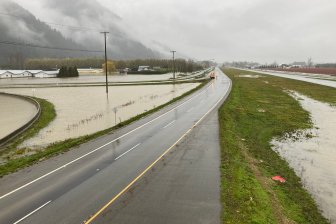
B.C. Premier John Horgan and Prime Minister Justin Trudeau have vowed to match flood relief donations to the Canadian Red Cross, and set up a federal-provincial cabinet committee to deal with the devastation of southern B.C. roads and farms.
Trudeau and Horgan spoke at the B.C. legislature Friday evening, in an appearance delayed as anti-pipeline and logging protesters chanted outside. Trudeau made no specific commitments, beyond a pledge that the federal government will be a “full partner” in the long road to repairs.
Horgan said questions about the financial impact of the flood and mudslide disaster are premature. He said an earlier decision to leave Fraser Valley dikes and flood control up to local governments has not worked, and the federal and provincial governments have to do a better job.
“Now the rubber hits the road,” Horgan said. “It’s going to take a bundle of money,” but he said he’s confident B.C. and Canada have a strong enough economy to do it.
Trudeau stressed the goal of “having Canadians’ backs,” and cited the federal government’s aid so far, $4.5 million to Indigenous communities on federal reserves, and another $4 million for the Port of Vancouver to deal with shipping, rail and highway disruptions.
Horgan credited Trudeau and U.S. President Joe Biden for their quick action to bring in gasoline and diesel fuel from U.S. by barge to replenish Southwestern B.C., where rail, roads and the Trans Mountain crude and fuels pipeline have been off line. He also said he has support from Washington Gov. Jay Inslee to deal with the Nooksack River flooding that washed out dikes in B.C.
The British Columbia and federal governments are striking a joint committee of ministers to address disaster response and climate resilience, and have agreed to match Canadians’ donations to Red Cross flood relief.
Prime Minister Justin Trudeau made the announcements Friday evening, after meeting to discuss the deadly landslides and floods that have devastated southwest British Columbia.
The new committee will be co-chaired by federal Public Safety Minister Bill Blair and B.C. Public Safety Minister Mike Farnworth.
“(It will) map out the way forward here in British Columbia and establish a model for how we’re going to move forward as a country facing extreme challenges like this,” Trudeau said.
“That will focus on establishing the way forward, that will focus on what is needed right now in the days to come … but also preparing for the rebuilds that will take many, many months and in some cases years,” Trudeau said.
B.C. floods: Climate and disaster committee will ‘map out the way forward,’ Trudeau says
B.C. floods: Climate and disaster committee will ‘map out the way forward,’ Trudeau says
Under the government donation matching program, the federal and provincial government will each contribute $1 for every dollar Canadians contribute to the Canadian Red Cross.
“I encourage British Columbians to give a dollar and there will be three dollars going towards helping people in distressed areas,” Horgan said.
The fallout of the Nov. 14 atmospheric river is shaping up to be the most expensive natural disaster in Canadian history, and while Horgan said it was “premature” to talk about dollar figures, he acknowledged “the dollars, the costs will start to mount.”
Trudeau pledged that the federal government would be there for B.C. with support in both the days and potentially years ahead.
Asked if that amounted to a blank cheque for disaster recovery, the prime minister said the federal government would commit to being a “full partner” in recovery.
“I have committed from the beginning that we will be here for whatever is needed,” he said.
“We need to rebuild, we need to rebuild more resilient infrastructure that’s going to be able to handle 100 year storms every few years … it’s going to be expensive, but it would be far more expensive to do less than not to do enough.”
B.C. Floods: PM visits flood-stricken Fraser Valley
B.C. Floods: PM visits flood-stricken Fraser Valley
Trudeau said the federal government has already deployed more than 500 troops to the province to help with the fallout of flooding, some of whom he met with on Friday, and who would be on the ground to help prepare for a series of storms expected to begin arriving Saturday.
The threat of future climate disasters featured prominently in both leaders’ remarks.
Horgan took pains to stress the scale — and unprecedented nature — of the damage in B.C., which for the first time in the province’s history cut all major road links to the Metro Vancouver area and pummeled parts of the interior that were hit by prior disasters this year.
“We’re facing the brunt of climate change not in the future but now. Our farms have been flooded, our farms have been washed away, and our communities are underwater and more rain is coming,” he said.
Weather and travel warnings issued ahead of two more storms
Weather and travel warnings issued ahead of two more storms
“This followed droughts and wildfires and heat domes this past summer, and I think it’s important for Canadians to understand that Merritt was facing drought conditions in May, wildfire conditions in June and July and now flood conditions in the fall.”
Trudeau pointed to damaging weather currently also hitting Canada’s east coast, and said such extreme weather events were expected to become more common in the years to come.
Earlier Friday, Trudeau toured the flood zone in Abbotsford’s Sumas Prairie, where crews have been working around the clock to bolster dikes as the province faces a series of new storms expected to deliver significant amounts of rain.
The prime minister met with Abbotsford Mayor Henry Braun along with members of rescue operations on Friday afternoon at Abbotsford City Hall, where Trudeau was briefed on the city’s efforts against flooding.
Trudeau, along with federal Employment Minister Carla Qualtrough, Emergency Preparedness Minister Bill Blair and B.C. Public Safety Minister Mike Farnworth, also met with Canadian Armed Forces members in Clayburn Village who were helping with sandbagging efforts.
Brooks Koepka and Bryson DeChambeau squared off in The Match on Friday in Las Vegas. Here’s a closer look at the clubs that the two stars used in their showdown:
The fifth edition of "The Match" was the first one that golf legend Phil Mickelson didn't compete in, but he still managed to participate from another place: the broadcast booth. He did not disappoint in his new role.
Friday's event, which featured rivals Bryson DeChambeau and Brooks Koepka going head-to-head, was Mickelson's official debut as a commentator — he has joined the booth in the past as a guest. Twitter loved his contributions to the Turner production.
One unique element of "The Match" is that the competitors have an airpod in one ear so they can constantly communicate with the broadcast team. Viewers are then able to hear the announcers talk golf with the competitors on the course. Mickelson's discussions with DeChambeau and Koepka were on point from the beginning.
After DeChambeau hit his first "bomb" of the round, Mickelson asked him if he thinks hitting bombs makes him more attractive.
Mickelson made headlines before the golfers even hit the course. He joined Bleacher Report's prematch show to discuss the competition. Mickelson said that he thought Koepka would take an early lead but DeChambeau would win. He was right about the first part, at least. Koepka made sure to remind Mickelson that his prediction was wrong as he continued to dominate.
This wasn't the only thing Mickelson predicted Friday. He regularly called Koepka's approaches, and most of the time he was right.
At times, Mickelson's techincal golf talk went over the head of fellow commentator Charles Barkley. Barkley made sure to ask for clarifications for himself or casual golf fans.
Fans on Twitter responded mostly positively to Mickelson. Many asked him to become a broadcaster whenever he retires from golf. Luckily for them, it appears Mickelson is interested in continuing his television career in the near future.
"We're always in discussions about Phil's future It wouldn’t surprise me if in the next 12 to 24 months you might see more of Phil on the air," Mickelson's agent, Steve Loy, told Front Office Sports ahead of "The Match."
Brooks Koepka defeated Bryson DeChambeau 4 & 3 in the fifth edition of The Match at the Wynn Golf Club in Las Vegas.
After an uneventful fall swing on the PGA TOUR, betting underdog Koepka polished off a dominating performance in the popular exhibition series.
Koepka put his foot on the gas early. After both players parred the first hole, Koepka rolled in a 15-foot birdie putt on hole No. 2. The four-time major champion then turned, looked back, and said, "Bryson, that's good," referring to DeChambeau's par putt.
It looked like the momentum was about to swing in DeChambeau's favor on the third hole when he fired a dart to 11 feet, while Koepka pushed his tee shot on the par 3 right of the green. However, Koepka then hit a beautiful chip to two feet, and DeChambeau missed the birdie chance.
After both players parred the fourth, the momentum again shifted Koepka's way when he hit a fantastic second shot to leave himself a 40-foot putt for eagle, while DeChambeau clipped the trees with his approach and landed short of the green. Koepka secured the two-putt and DeChambeau fell two behind.
Sensing blood in the water, Koepka hit his approach on the par-3 sixth hole to 11 feet. DeChambeau countered with a worthy approach of his own, but the eight-time TOUR winner once again failed to convert. Koepka, on the other hand, drained his birdie putt before saying, "Any questions?"
After both players parred the seventh hole, Koepka slammed the door shut on the eighth hole with another clutch birdie.
With Koepka four up and with just four holes to play, both players hit the green on the par-3 ninth hole. DeChambeau conceded the match after missing his birdie attempt once again.
"Where is this on the PGA TOUR, man?" DeChambeau asked Koepka. "You play so good right now."
"It's kind of like my major right now, right?" Koepka responded. "Not going to lie, I just wanted to spank you."
When asked if a rematch was in store, Koepka kept his cards close to his chest.
"We settled it," Koepka said.
Both DeChambeau and Koepka are set to compete next week in Tiger Woods' charity event, the Hero World Challenge, in Albany, Bahamas.
Magnus Carlsen this week launched his attempt to retain the chess world championship once again, with reason for confidence. The Norwegian grandmaster is favourite to win the 14-game tournament in Dubai against Ian Nepomniachtchi of Russia, and chess is enjoying a renaissance, helped by last year’s Netflix drama, The Queen’s Gambit.
As the players settle down to what is likely to be a series of tight matches that mostly end in draws, two questions linger. One is whether, win or lose, this will be Carlsen’s last defence of the title he first won in 2013 at the age of 22. The second is trickier: is there much pleasure left in watching two humans play championship chess?
It was never the most scintillating experience to observe opponents hunched over a square board for several hours. Chess is not like football or other sports, where chance and skill are evident, and viewers can see a star stretch for a ball, or bend it inside the post. In chess, one piece is moved at a time and a player’s mental turmoil is often expressed with a slight frown.
Yet there have been times when chess has embodied the off-board struggle for victory, with all of its high emotion, notably the cold war matches between Bobby Fischer and Boris Spassky in the 1970s. The clash of personality was the clash of nations, and Fischer helped by playing brilliantly to beat Spassky in 1972, a victory echoed by the fictional Beth Harmon in The Queen’s Gambit.
There was also stirring symbolism in the twin matches between Garry Kasparov and IBM’s Deep Blue, ending in the machine beating the champion in 1997. Since then, brute computing power has been overtaken by artificial intelligence, with DeepMind’s AlphaZero teaching itself the game in four hours and crushing the leading chess machine Stockfish in 2017, despite the latter’s capacity to consider 60m chess positions per second.
After such knowledge, what forgiveness for human chess? No matter how ingenious the battle of wits between Carlsen and Nepo, as he is known, a rookie with Stockfish on a smartphone knows a strong next move, even if not understanding why. Igors Rausis, the Ukrainian-born grandmaster, was caught consulting his phone in the toilet during one match in 2019 and cheating is a constant threat in modern chess.
Personality still matters. A contest between two AI agents would be extraordinarily advanced, but also too soulless to be interesting. As GK Chesterton wrote in his essay “The Perfect Game”, “If you could play unerringly, you would not play at all. The moment the game is perfect, the game disappears.”
Carlsen’s wry good humour, along with his youthful rise, have been good for the game; although he plays with ironclad consistency, he is fan-friendly. He has also adapted to the digital era, in which matches may not only be played online but players can chat as they are followed by thousands of others.
Chess has even gained a niche in esports, the peculiar but thriving industry built around fans watching others play games including Fortnite, Grand Theft Auto and Dota 2, on platforms such as Twitch. One leading Twitcher is Hikaru Nakamura, the five-time US champion whose fighting spirit extended to having a physical brawl with a Canadian grandmaster after one bad-tempered match.
The problem is not that computers have replaced people, but that they have curtailed their space for adventure, especially in “classical” chess played under long time limits at championship level. Players always arrived for tournaments well prepared, but they now use software as well as human analysis to predict lines long past the opening.
That leads to what the grandmaster Jonathan Tisdall calls “the ever increasing difficulty of winning games at slow time controls” — in matches that last hours, humans prepared by chess machines can manoeuvre each other to a standstill. In Carlsen’s last title defence in 2018, all 12 of the classical games (before rapid tiebreakers) were drawn.
Draws can be exciting, but computer preparation also militates against behaving originally. Where once players might have used risky moves to push opponents off balance, now they tend to play safer and more sturdily to avoid dangerous errors. “I think the era of Kasparov’s [dynamic and creative] style is gone. I think it is impossible to play this way any more,” said the Uzbek grandmaster Rustam Kasimdzhanov of the world championship game.
Artificial intelligence has heightened chess’s old fear of “draw death”, where the game is analysed to the degree that wins disappear. Carlsen often plays faster games such as “bullet chess” that force players to move quickly and instinctively rather than sink into analysis, and has even backed changing the format for championships.
The contest in Dubai is a test, for Nepomniachtchi is known as a risk-taker. If he cannot restore jeopardy, what will? José Raúl Capablanca, the former world champion known as “the chess machine”, once suggested increasing the size of the board and introducing two new pieces for variety. If machines rule, we can change the rules.
The biggest feud in golf this year between Bryson DeChambeau and Brooks Koepka will take center stage during the fifth edition of "The Match" on Friday, Nov. 26.
The format for this edition of "The Match" will mirror what the 2021 Ryder Cup used in one-on-one golf matches. It will be a bit more simple than other editions of "The Match" in previous years.
However, the biggest difference for this fall's event is the two golfers will only compete in a 12-hole round rather than playing all 18 holes.
Sporting News has you covered with a breakdown of the rules, format and scoring system to be used in "The Match."
The Match rules and format
"The Match 5" will follow the match play format for the entirety of the round. This will only be the second time in "The Match" history where match play will be the only format. The previous time match play was used was in the first match between Tiger Woods and Phil Mickelson.
What is match play in golf?
Similarly to what is used in the one-on-one competitions in the Ryder Cup, players will compete to shoot the lowest score on each hole. A point will be awarded to whoever shoots the lowest score on the individual hole. If they tie on a hole, that hole will be halved. Whoever wins the most holes by the end of 12 holes wins.
In the first edition of "The Match," Woods and Mickelson went into four sudden death holes because they were tied at the end of 18 holes. It is believed DeChambeau and Koepka will do the same if they are tied at the end of 12 holes.
How does match play scoring work?
Whoever wins the hole earns one point, while the loser of the hole earns zero points. If the two golfers shoot the same score on a hole, they will each earn a half-point. Unlike regular golf play, whoever has the highest score at the end of 12 holes will win the match.
It is possible for a winner to capture a victory before all 12 holes are played. For example, if a golfer is up two holes with one hole to go, they will finish the match because they would win regardless.